I Built a Work Time Tracker for Solo Entrepreneurs
What I Recently Felt While Working as a Freelancer
I was never really the type of person who liked to track my working hours. This might be because software development, as a field, is one where whether the task was completed matters more than how many hours were spent working. A person who took 8 hours to finish task A and a person who finished task A in just 1 hour have actually produced the same result. However, I also find it a bit strange that if wages are calculated on an hourly basis, the person who worked 8 hours should be paid more. So I tended to focus on completing the work and not worry too much about tracking my working hours.
But through a recent incident, I came to painfully realize that not tracking my working hours was a big mistake. I ended up handling work for a company as a freelancer, and a rather excessive amount of work was assigned to me. With the mindset of not worrying too much about tracking my hours and instead focusing on getting the work done, I tried to work day and night. As I did this, I found myself working until 3 AM and even working at 7 in the morning. Perhaps because I worked for such long hours, I experienced becoming exhausted both physically and mentally. On top of that, because I hadn’t tracked my working hours, I ended up in an awkward position where it was difficult to bill the client.
Of course, part of the reason I didn’t track my working hours is that, personally, I hold the view that billing by the hour isn’t a particularly good method. But after experiencing how it seemed to negatively affect my health and made billing awkward, I came to think that tracking working hours is truly necessary—not just for the purpose of billing clients, but also to prevent things like burnout. So this time, I ended up building the “Work Time Tracker (Kkachi Work Clock).”
What I Felt While Working as a Solo Entrepreneur
I once measured my time while working at a company in the past. For most office workers, an 8-hour workday (9 to 6, 10 to 7) is the typical form of work, but in reality, when I supposedly worked 8 hours, the time I was truly and fully focused amounted to only a few hours. I also experienced that after concentrating on writing programs for about 4 hours, my mind would become worn out, making it hard to write any more code. Since 4 hours seemed surprisingly short, I searched for information online, and I was able to find plenty of articles saying that about 4 hours a day is indeed the limit of a person’s concentration. Of course, when you work 8 hours, there are things like meeting times and time spent checking emails—these aren’t times of intense focus, but they are time spent on work, so perhaps 8 hours is an appropriate amount for working hours.
However, since I started working as a solo entrepreneur, the concept of having to clock in at 9 AM disappeared, and so did the concept of having to work 8 hours. Of course, the fact that the concentration resource I can use per day is still 4 hours probably hasn’t changed. In a way, software development as a field may itself be one that extracts a programmer’s concentration to create a product called software. Recently, AI has advanced a lot, so the story might be a little different, but before AI, it was probably that kind of field. Even if it’s not necessarily software development, thinking that concentration is limited to 4 hours a day made me want to make use of this precious resource every single day.
In that sense, I thought it would be good to use this program to check whether I’m working at least 4 hours or more every day. Because I’m a solo entrepreneur, there are times when I end up wasting an entire day, and I built this with the thought that if I could check how much I worked through a program like this, I might be able to spend each day in a more productive way. For these kinds of attendance management programs, it seems that preventing fraudulent use is an important element, but since I made this for solo entrepreneurs, I didn’t consider such elements much. Since it’s for checking on yourself, there wouldn’t really be any reason to lie about how much you worked. If I ever end up building an attendance management program for bosses in the future, I should build it with those elements included as well.
Introducing the Work Time Tracker (Kkachi Work Clock)
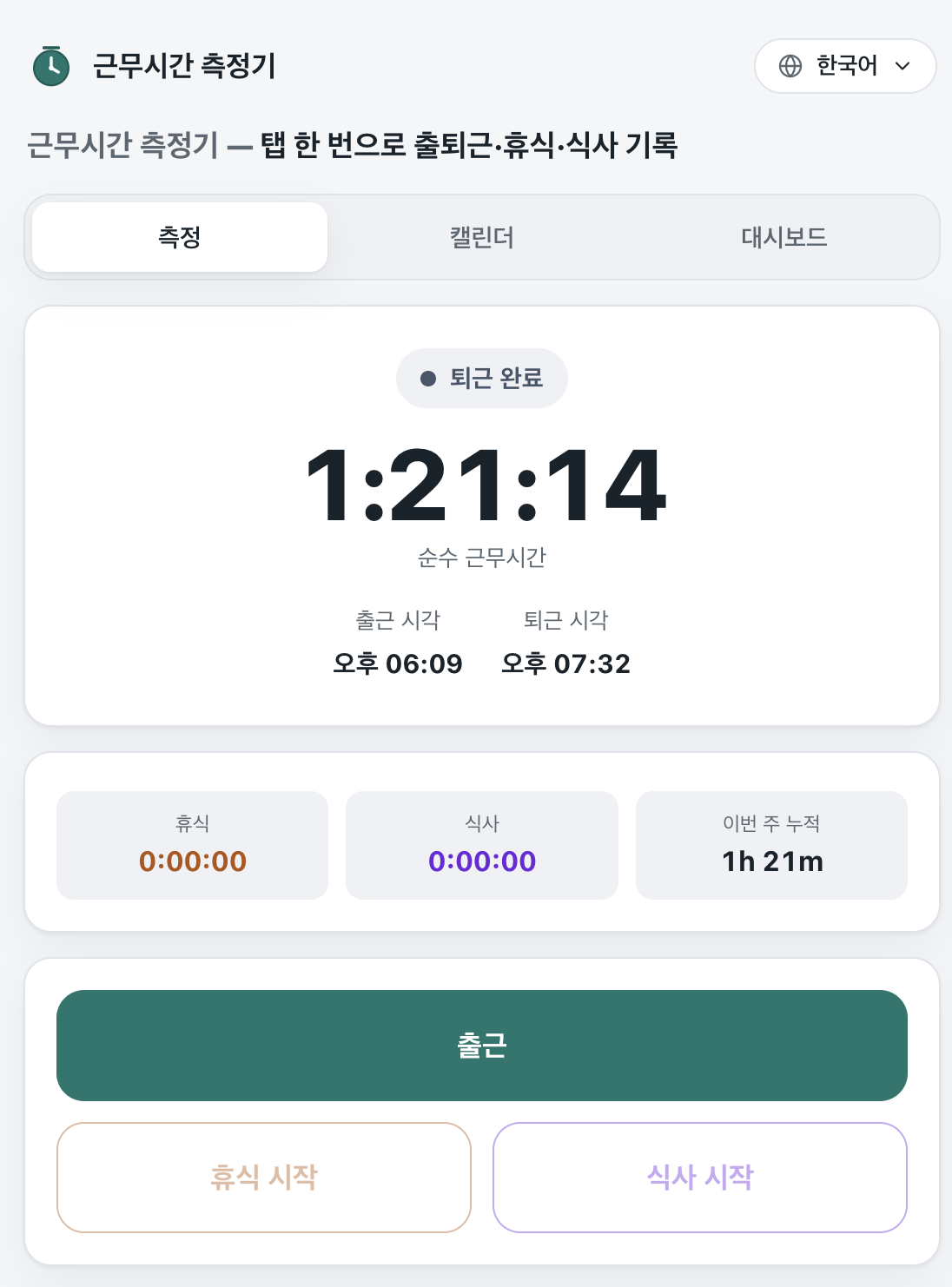
Using this app is very simple. No login is required, and no data is saved to the server. You just press the clock-in, clock-out, break, and meal buttons in your browser, and it measures the time for you automatically. It’s a very simple program, but I hope it helps those who need it.
Link: https://work-clock.kkachi.app